How AI-Powered Resume Writing Actually Works (Behind the Scenes)
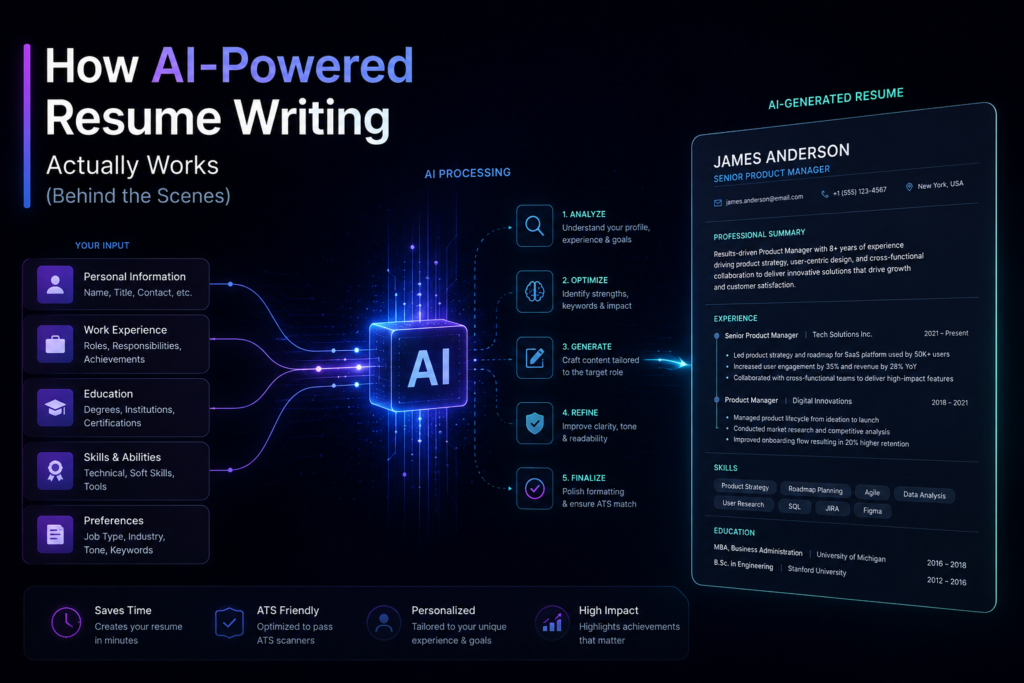
There’s a lot of vague marketing around “AI-powered” resume tools. Most of them pipe your information into a large language model, get some text back, and dump it into a template. The result is generic, wordy, and reads like every other AI-generated resume out there. I want to walk through how we handle AI in KitAura, because I think the details matter. Two different AI models for two different jobs Not every task needs the same AI model. Writing polished professional copy requires a capable model that understands tone, context, and brevity. Checking spelling doesn’t. We use Claude Sonnet for content generation. When you click “AI Fill” on your experience section, Sonnet reads your career profile your actual job titles, companies, dates, and descriptions and rewrites them into achievement-focused bullet points. It costs us about $0.012 per call, which sounds tiny until you multiply it by thousands of users. For spellchecking, we use Claude Haiku. It’s cheaper ($0.004 per call), faster, and more than capable of catching “developement” and “managment.” We don’t need a powerful model to find typos. This routing happens server-side. You never see which model is working behind the scenes. You just click a button and get results. The formatting problem nobody talks about Here’s something that frustrated me for weeks during development. When an AI generates text for your CV, what format should it be in? Plain text? Markdown? HTML? None of those work. Your CV template has specific fonts, colors, and sizes for each section. The experience heading might be bold, navy blue, size 13. The job titles might be bold, black, size 11. The bullet points might be regular weight, dark grey, size 11. If the AI returns formatted text with its own styling, it overrides your template’s design. Every template would look the same after AI Fill, which defeats the purpose of having templates. Our solution: the AI returns plain structured text just the words, organized by role. Then the app reads the existing template formatting (what color is the heading? what size are the titles? what font are the bullets?) and applies those same styles to the new text. The template’s design stays intact. Navy templates stay navy. Pink templates stay pink. The AI only changes the content, never the appearance. Your API key never leaves the server This is a technical detail most users won’t care about, but it matters for security. The AI API key is stored in Google Cloud Secret Manager. When you click AI Fill, your browser calls our Firebase Cloud Function, which adds the API key server-side and forwards the request to Claude. Your browser never sees the key, never sends it, and can’t access it through browser developer tools. We also track every AI call server-side token counts, costs, timestamps so usage counters can’t be manipulated from the frontend. The paywall is enforced before the AI call happens, not after. What AI is bad at (and we don’t pretend otherwise) AI is bad at knowing what’s true about you. It can polish “I built a mobile app” into “Architected and deployed a cross-platform mobile application,” but it can’t verify whether you actually did that. Everything the AI writes comes from data you provide. If your career profile is empty, the AI has nothing to work with. It’s also bad at personal summaries. The “Professional Summary” section is the hardest to generate because it requires synthesizing your entire career into 2-3 sentences. Our AI gives you a starting point something like “Senior Flutter Developer in Technology with a track record of delivering results” but you should rewrite it in your own voice. Hiring managers can tell the difference. Try it yourself: kitaura.winibex.com — the AI Fill works even on the free plan.
Why Most CV Builders Feel Like They Were Designed in 2012
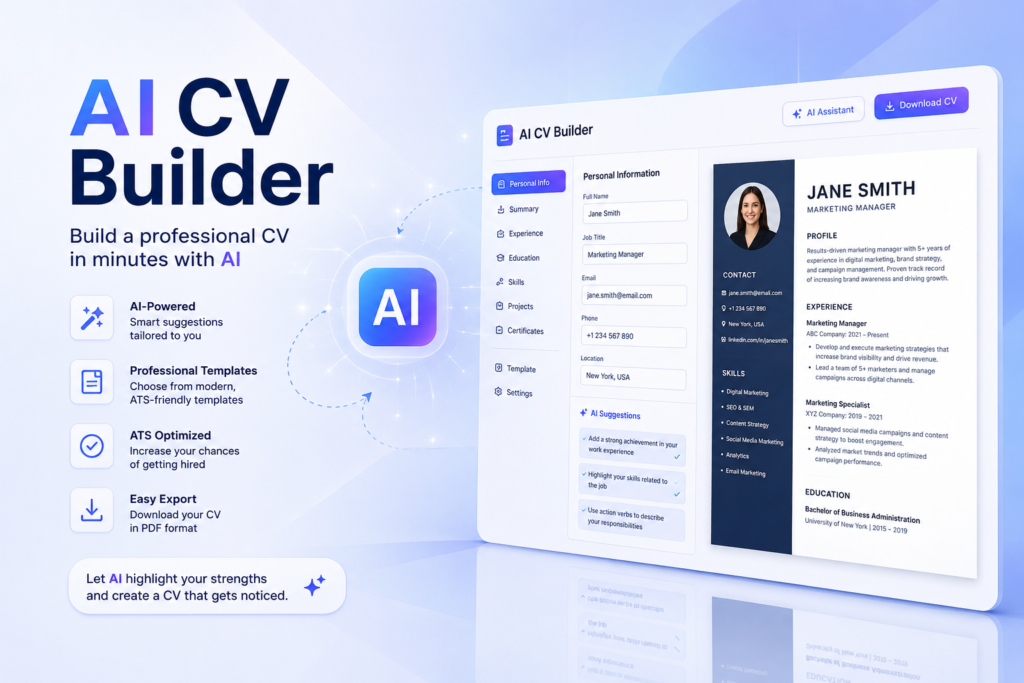
I’ve tried probably 20 CV builders over the past few years. The free ones give you three templates that all look like they were exported from Word 2007. The paid ones charge $15/month to let you download a PDF of your own information. None of them let you actually design anything. Here’s the thing about resumes in 2026: everyone has one, and they all look the same. The same blue header, the same bullet-point list, the same “results-driven professional” opening line. Hiring managers scan your CV for about 6 seconds before deciding whether to keep reading. If yours looks identical to the last 40 they saw, you’re already at a disadvantage. The problem isn’t the content. It’s the tools. Most resume builders work like a form. You fill in boxes name here, job title there, education below and the tool spits out a PDF in one of maybe 8 templates. Want to move a section? Can’t. Want to change the font size of just one heading? Nope. Want to put your skills on the left side instead of the bottom? Not an option. That’s why we built KitAura differently. Instead of a form, you get a canvas. Like Canva, but specifically for professional documents. Every text section, every shape, every line is a separate element you can drag anywhere. Resize it, change the font, pick your own colors. If you want your education section above your work experience because you just graduated, drag it up. Done. Where AI actually helps (and where it doesn’t) The word “AI” gets slapped on everything now, so let me be specific about what ours does. When you add a work experience section and click AI Fill, it reads your saved career profile your actual job titles, companies, dates, responsibilities and rewrites them into polished, professional bullet points. It doesn’t hallucinate fake companies or invent metrics. It takes what you give it and makes it sound better. The formatting stays exactly as your template defined it. Navy blue headings stay navy blue. Bold job titles stay bold. The AI changes the words, not the design. This took us a while to get right, and it still isn’t perfect, but the principle matters: your CV should look like you designed it, not like a robot generated it. What about ATS compatibility? Applicant tracking systems parse your CV as text. They don’t care about your gradient header or your custom icon. What they care about is whether the text is actual text (not an image), whether the section headings are recognizable, and whether your keywords match the job description. KitAura exports clean PDF with real text layers. The section headings use standard names (Experience, Education, Skills) that ATS systems recognize. And because you can see exactly how the final document looks before exporting, there are no surprises. Free tier, no tricks The free plan gives you 3 documents, 15 AI fills per month, and 3 exports. No watermark on the design itself just a small “Made with KitAura” footer on free exports. Spellcheck is free for everyone. If you’re making one CV for one job application, the free tier covers it. Pro unlocks unlimited everything for $7/month, with a 14-day free trial if you want to test it properly. No annual lock-in, cancel anytime. We’re a solo developer building this from scratch. No VC funding, no growth-at-all-costs pressure. Just trying to make a CV builder that doesn’t suck. Try it: kitaura.winibex.com